


Mass Spectrometry for Cosmic SamplesProvided by; Planetary & Space Sciences Research Institute; The Open University Homepage:http://www.open.ac.uk/science/pssri/about-the-department/facilities/pssri-facilities.php? |
 |
Scientific Contact:Dr Ian FranchiPlanetary & Space Sciences Research Institute The Open University Walton Hall, Milton Keynes MK 7 6AA, UK Email: Phone 00 44 1908 655173 |
Local administrative contact (once a TNA visit is awarded):Ms B J BishopDepartment of Physics and Astronomy, Phone 00 44 1908 655253 Fax 00 44 1908 654192 |
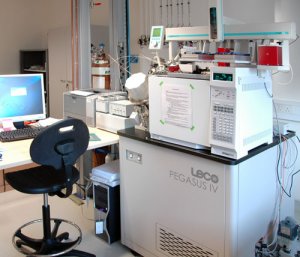
Leco Pegasus IV GCxGC-TOFMS
Leco Pegasus IV GCxGC-TOFMS - mass spectrometric complete characterisation of very complexmixtures of organic materials. The Pegasus 4D GCxGC-TOFMS system, from Leco, provides the analyst with four dimensions of analytical resolution for significantly more complete sample analysis compared toconventional GC-Mass Spectrometry. The main advantages include:
|
 |
Thermo MAT 253 GC-IRMS
|
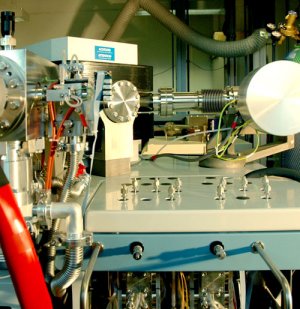
Thermo MAT 253 GC-IRMS -isotopic measurements of H, C or N on individual organic compounds in complex mixtures. One of only a few instruments of this type worldwide primarily dedicated to the analysis of extra-terrestrial materials. Supported by fully equipped sample preparation laboratories and GC-Mass Spectrometers required to develop the exact methodology necessary for optimal analysis of each sample. A number of different sample introduction injection and pyrolysis systems are available. Open University is one of the leading laboratories in the world for compound specific isotopic measurements of extra-terrestrial organics and this is one of a very few instruments of this type in the world largely dedicated to extra-terrestrial materials. |
 |
Ar/Ar Nu Instruments Noblesse
|
Ar/Ar Nu Instruments Noblesse is coupled with an ultra-low volume extraction line and with a choice of 213 nm UV laser or 1090 nm IR lasers, providing a wide range of analytical capability in Ar/Ar dating of lunar and meteorite samples. This instrument is unique with a mass resolution of 3000, and with the UV laser it has the capability to measure Ar isotope variation on a ca. 30 -micron resolution enabling detailed mapping of age and apparent age variation within minerals. The 1090 nm laser provides the capability to step-heat amall samples. The laboratory is fully supported by sample preparation facilities and technical expertise in lunar and meteorite Ar/Ar analysis. |
Facility References
Selected relevant publications
For information on the Europlanet TNA programme contact:
Professor N J Mason, Department of Physics and Astronomy, The Open University, Walton Hall. Milton Keynes, MK7 6AA
Email (preferred method of contact)
 Print this page